Laboratoire SoMA

Quantitative microbial life sciences.

Below are three coarse-grained themes of our research.


01 / Laws

Macroecological patterns and the models that generate them

Abundance distributions, the scaling of variance with mean, the relationship between occupancy and abundance are examples of macroecological patterns that recur across soils, oceans, hosts and bioreactors. We ask what minimal process(es) are capable of their generation. A stochastic logistic model of growth, with environmental noise and a carrying capacity, turns out to reproduce a surprising amount of it, which raises the more interesting question of what it cannot do.

Related work: eLife 2024, Nat. Ecol. Evol. 2017, a survey and outlook.
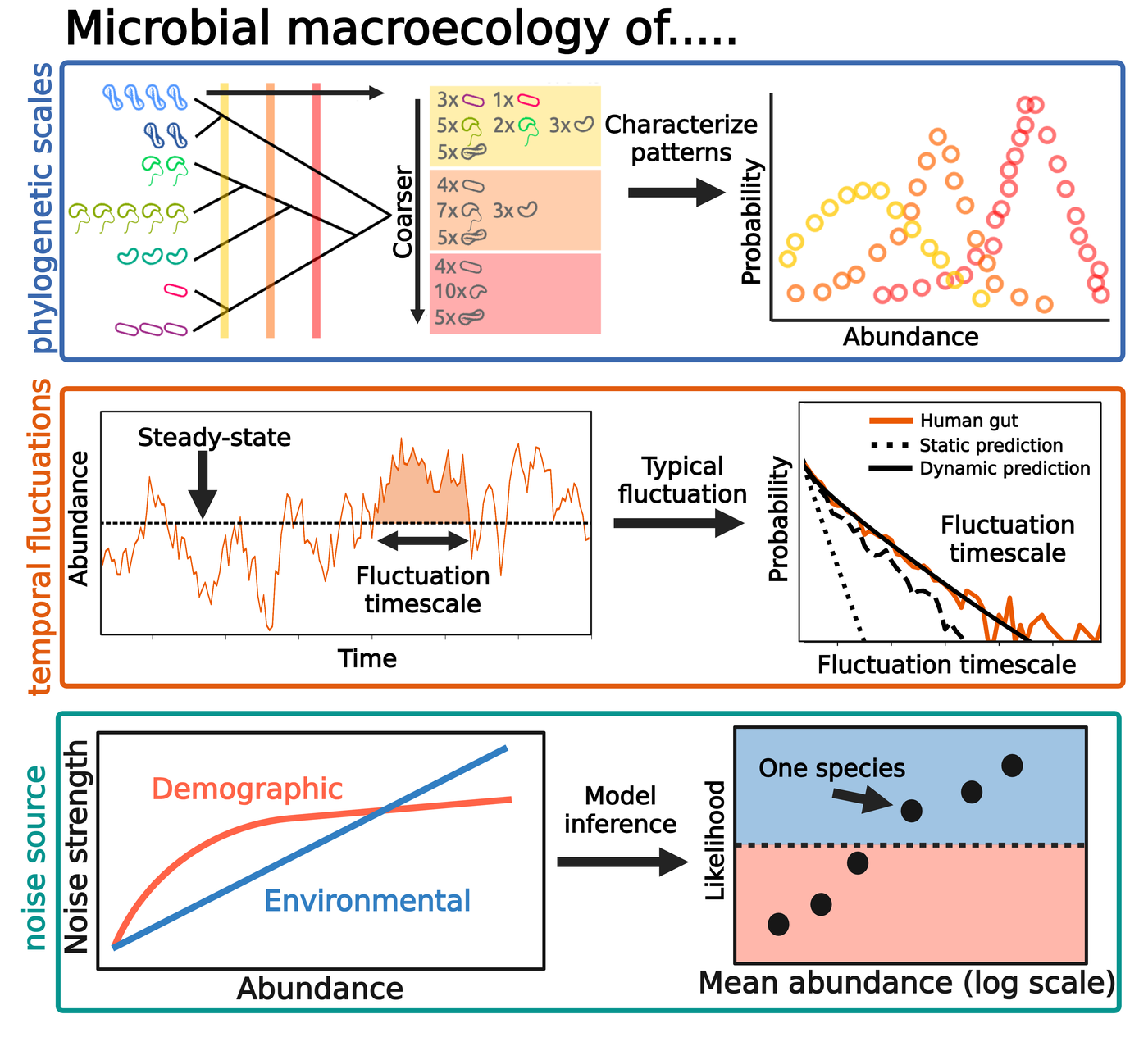
Three-panel schematic. Top: a phylogeny is cut at coarser and coarser scales, the taxa in each bin are counted, and the resulting abundance distributions are compared. Middle: an abundance time series fluctuating about a steady state, with the typical duration of an excursion measured and its distribution compared against static and dynamic predictions. Bottom: demographic and environmental noise scale differently with abundance, and model inference assigns each species to one or the other.
Three ways of asking the same question. How abundance distributions change as taxa are coarse-grained up a phylogeny; how long a typical fluctuation lasts; and whether the noise driving those fluctuations is demographic or environmental.

02 / Experiments

Putting laws to the (experimental) test

Patterns observed in natural communities are easy to explain, hard to falsify, and impossible to manipulate. Here, experimental communities come in handy, allowing us to fix the environment, replicate it, perturb it, then ask whether statistical regularities hold.

Related work: PLOS Comput. Biol. 2025, bioRxiv 2025.

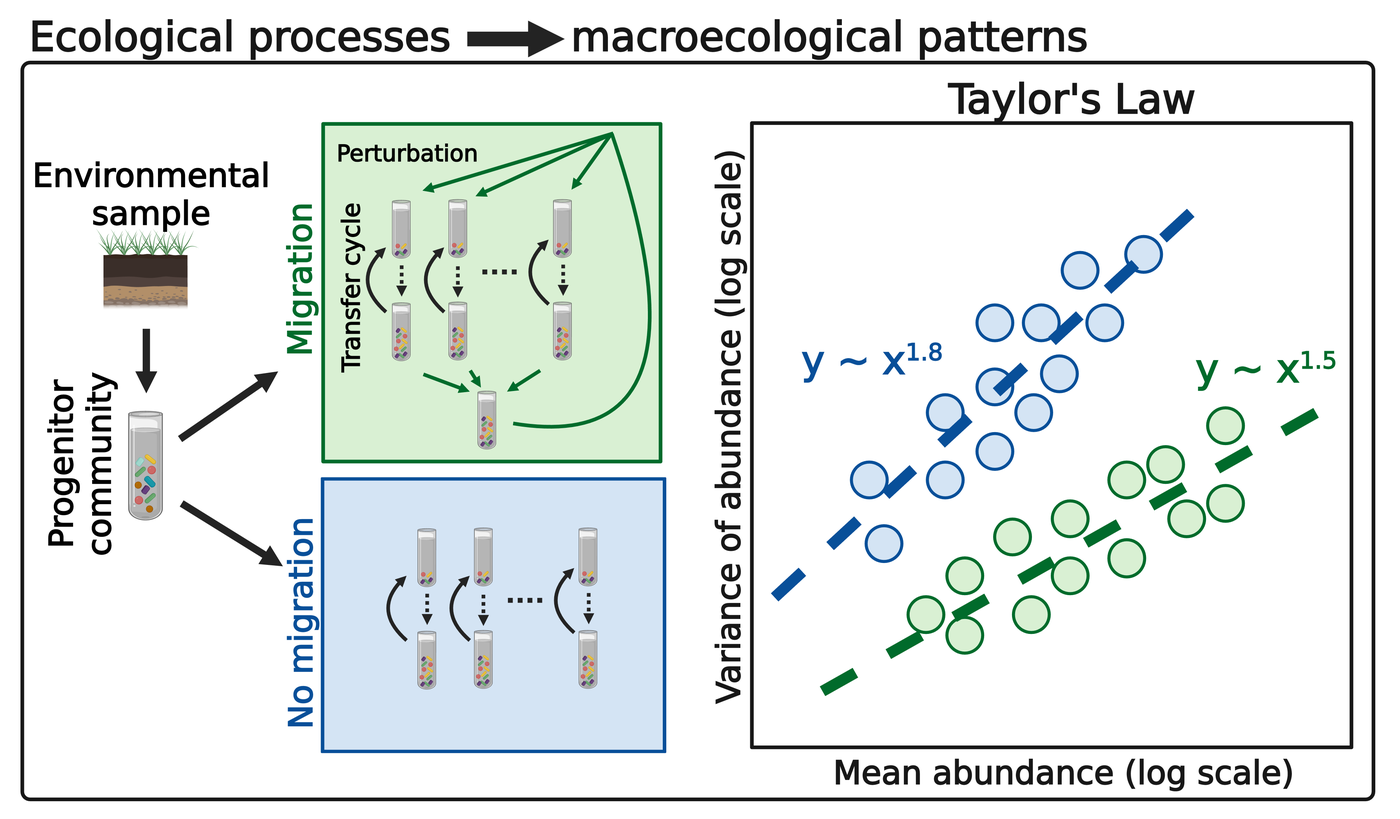
An environmental sample seeds a progenitor community, which is split into two experimental regimes: one with migration and periodic perturbation between replicate tubes, one without. The resulting communities are compared through Taylor's law — variance of abundance against mean abundance on log axes — where the two regimes give different scaling exponents, roughly 1.8 without migration and 1.5 with it.
Ecological processes leave macroecological signatures. Replicate communities propagated with and without migration separate cleanly under Taylor's law, the scaling of abundance variance with mean.

03 / Life history

Dormancy, energy limitation and the cost of waiting

Most microbial cells, most of the time, are not growing. Sporulation as a Bacillota life-history strategy produces a seed bank that buffers populations against deleterious conditions. This reservoir of genetic and phenotypic diversity dampens evolution and its efficacy is determined by cell bioenergetics.

Related work: PNAS 2026, Mol. Biol. Evol. 2021, Evol. Appl. 2018.

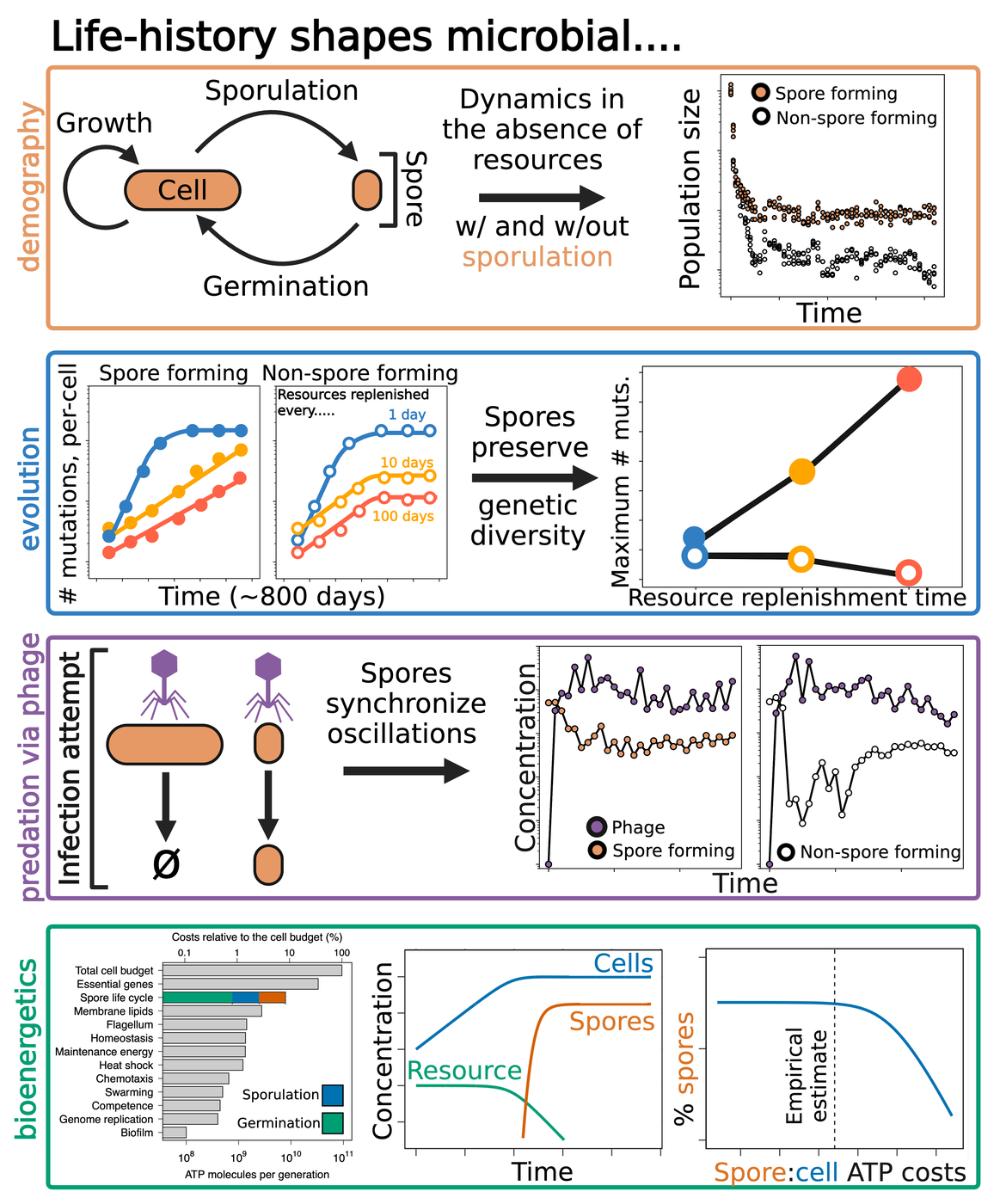
Four-panel schematic of how a dormant life history changes microbial biology. Demography: cells sporulate and germinate, and populations that can form spores persist at higher numbers than those that cannot once resources run out. Evolution: mutations accumulate more slowly the longer resources are withheld, and spore-forming populations retain more genetic diversity than non-spore-forming ones. Predation: phage cannot productively infect spores, which synchronises phage-host oscillations. Bioenergetics: the spore life cycle costs a few per cent of a cell's ATP budget, and the fraction of the population that sporulates falls as that cost rises.
What dormancy changes. Populations persist without resources, spores preserve genetic diversity that active cells would lose, phage cannot infect a spore, and the whole strategy is paid for out of a cell's ATP budget.

Code & data

Analysis code for our papers is on GitHub, and processed data are deposited on Zenodo. Every entry on the publications page links to whatever exists for that paper.